


When I Fell in Love with Science Fiction

Growing up, I was always a curious reader. I enjoyed exploring new genres and all kinds of books and movies. But there was one genre I believed I could never really be friends with: science fiction.
Sci-fi always felt like it spoke a language I could not fully understand. My earliest interactions were through films like Star Wars and recommendations like Jurassic World. Both came with the promise that they were “ahead of their time” and that I would absolutely enjoy them.
Well, I didn’t. I found them intimidating and overwhelming. They left me demotivated to ever try science fiction again. Cut to 2026. I was trying to rebuild my reading habit and thought it might be fun to experiment with sci-fi books.
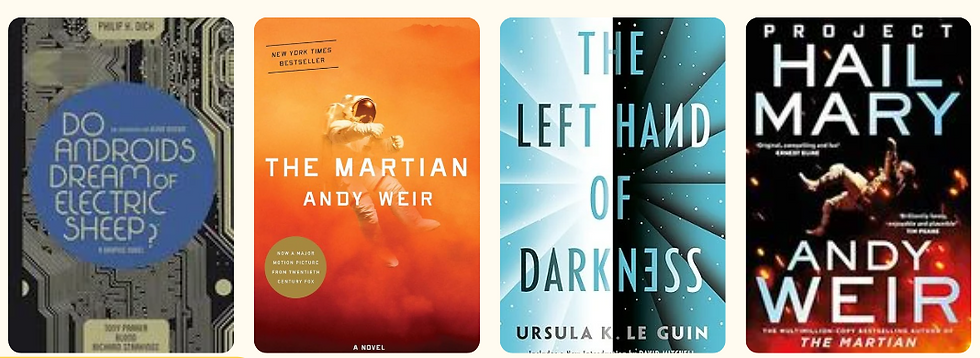
What began as a simple reading challenge slowly became a reflective journey of falling in love with the genre. It made me wonder: what exactly was it about science fiction that attracted me so deeply?
My first proper sci-fi book was Philip K. Dick’s Do Androids Dream of Electric Sheep?
It was part of my school curriculum and at first, of course, I saw it as a threat.
I was completely demotivated to read it. But thanks to the surprising quality of life, I ended up finishing it overnight because I was so consumed by the story. I needed to know how it ended.
The book asks whether empathy is what truly separates humans from androids. It explores morality, identity, and what it means to be human. At that point, I was deeply impressed by the writing because I could build the entire movie in my mind while reading the pages. For me, empathy begins when I find it difficult to put myself in someone else’s shoes, but still try. This story made me feel so many conflicting emotions about the androids. I found myself questioning what being human really is.
That was one of my first conclusions about sci-fi, and it keeps you on the edge of your seat. The emotional tension and unexpected turns make the experience incredibly immersive. Another thing that convinced me about science fiction is how beautifully it works both as literature and cinema. Blade Runner, the film adaptation of Do Androids Dream of Electric Sheep?, interprets the same story differently, yet both versions leave a powerful impression. While the movie made us believe androids are as human as we are, the book was slightly more nuanced with leaving the readers to draw their own conclusion. Making the readers question the android and the role that they play in society.
Then there is Project Hail Mary by Andy Weir. People's response to its screen adaptation felt personal to me. Because I read it on my Kindle in 2021, when the world was still recovering from Covid and I was readjusting to our normal life. The themes of friendship and identity felt like exactly what I needed at that time, even if on an online medium. It almost served as a reminder to be kinder to others and to myself.
Sci-fi transports us away from reality through fictional worlds, but at the same time, it asks deeply human questions. It gives us distance, but somehow brings us closer to ourselves.
My favourite read of this year so far has been The Left Hand of Darkness by Ursula K. Le Guin. It created a world where gender, as we commonly understand it, does not exist. The book made me imagine a society free from gender expectations and sexual prejudice.
Reading it felt liberating. It constantly pushed me to reflect on how the protagonist navigated relationships on a planet where gender is an alien concept. It genuinely fostered deep empathy in me. Unsurprisingly, this book was banned in certain places because of its themes around gender fluidity 🙄.
As isolated sci-fi stories may sound, due to the fictional setting of them. I have realised it can also act as a social commentary, predicting a world we may actually be heading towards. It does that by making complex issues revolving around our societies easier to understand.
A classic example is George Orwell’s Nineteen Eighty-Four, a story about thought policing, surveillance, and authoritarian control. The figure of Big Brother represents a society where freedom is fragile and every thought can be monitored. While reading it, I could not help but draw parallels between Big Brother and Bigg Boss, the TV shows. The book warns us about the fragility of freedom, while the show, in its own strange way, shows us how pressure and control can affect people.
But sci-fi does not always have to look dystopic. Sometimes, it can look hopeful too.

A story that stayed with me was The Martian by Andy Weir.
I watched the film when I was around 16 or 17, still very much not a fan of sci-fi. A few years earlier, I had watched Gravity and concluded that space movies were simply not my thing. And then I watched The Martian. It took me through a complete rollercoaster of emotions, but by the end, my heart felt full. I still vividly remember the hope and spark I felt after watching it. That is what sci-fi can do so well.
It creates tension and conflict, but it also offers perspective on human struggle.
At its core, science fiction entertains, but it also serves a deeper purpose. It keeps us hooked while making us question larger social and philosophical concerns. Whether it is inspiring hope for the future, fostering empathy, or challenging us to rethink the systems we live in, sci-fi manages to do all of this in a way that still feels exciting and accessible.
And maybe that is why I fell in love with it.
Not because I suddenly understood every spaceship or futuristic world.
But because somewhere inside all that imagined possibility, I kept finding very real parts of myself.


Comments